
A motorbike will fall over when in a parking area, lose its balance when making a slow turn or wake after an unexpected accident within the road. The smallest accident may harm some of their expensive components, such as the engine casing, fairings, exhaust, and frame. That is why most riders believe it is better to add such safety devices as crash bars and frame sliders. The two accessories are developed to minimize damage to motorcycles, but they function differently. Crash bars are more extensive protection around the engine and the lower frame, whereas frame sliders are more localized protection at distinct mounting points. The correct decision is based on your motorcycle, riding style, and the kind of falls you would like to prepare. In this guide, we compare crash bars and frame sliders, explain their advantages and limitations, and help you decide which option suits your bike. What Are Motorcycle Crash Bars? Motorcycle crash bars (also called engine guards) are tubular metal bars that are fitted on the frame of the motorcycle or special mounting points. They tend to be circular around the engine and the lower part of the motorcycle to provide a protective shield. Also, crash bars are particularly useful for riders who want broader protection around the engine and lower frame. However, their effectiveness depends on the motorcycle’s design, mounting points, and the type of impact. What Are Frame Sliders? Frame sliders are small protective items that can be fastened to the frame section or engine supports of any motorbike. They are commonly manufactured out of nylon, polyurethane, Delrin or any other impact-resistant substances. Frame sliders are particularly common with sportbikes and street motorcycles since they offer focused protection at the cost of a non-tubular crash bar. Others fit without having to cut the fairing, and some actually need holes to be drilled into the bodywork of the motorcycle. Crash Bars vs Frame Sliders: Key Differences 1. Protection Coverage Crash bars generally offer wider coverage. They can help protect the engine, lower frame, exhaust components, and other parts depending on their design. Frame sliders provide more targeted protection. They are usually positioned near the frame, engine mount, or fairing and are designed to protect those specific areas. 2. Motorcycle Compatibility Both crash bars and frame sliders are usually model-specific. A product designed for one motorcycle may not fit another, even if both bikes have similar engine sizes or body shapes. Crash bars typically need to match the frame structure, engine position and mounting points. Frame sliders must also be compatible with the frame or engine mounting system. 3. Weight and Appearance The crash bars are larger and mostly increase the weight of a motorcycle. They also provide a more conspicuous look, which is desirable to some riders on cruisers and adventure bikes. Frame sliders are less noticeable and smaller. These only add a moderate amount of weight and do not tend to produce a significant effect on the overall looks of the motorcycle. 4. Installation Many model-specific crash bars attach directly to existing mounting points and do not require cutting or drilling. However, installation difficulty varies between motorcycles. Frame sliders can be easy to install when they use existing mounting points. Some designs, especially fairing-mounted sliders, require modifications to the bodywork. How Do Crash Bars Protect a Motorcycle? Crash bars are designed to create space between the motorcycle and the ground during certain falls. When the bike tips over, the bars may absorb some contact and prevent sensitive components from directly striking the road. They can be particularly useful during: Parking-lot falls Low-speed tip-overs Slow U-turn incidents Drops on uneven terrain Certain off-road falls However, crash bars are not designed to make a motorcycle crash-proof. During a high-speed collision, they may not prevent damage to the frame, engine or other parts. The design also matters. A guard that is poorly fitted or mounted to unsuitable points may not provide the protection expected from it. How Do Frame Sliders Work? Frame Sliders are constructed to serve as a contact point between the road and the motorcycle. They also have the ability, in some sliding crashes, to prevent bodywork and chosen mechanical parts from coming into contact with the surface. Their most common applications are on sportbikes since these are motorcycles whose fairings are usually expensive and may be ruined in the case of a low-side crash. For more information, read a guide on restoring motorcycle plastics to understand more about cleaning, repairing, and enhancing the appearance of motorcycle bodywork. FAQs 1. Is a crash guard on a bike illegal in India? In India, crash guards are not always illegal; however, illegal and unsafe crash guard accessories or those designed inadequately may involve legal liability and pose safety risks. 2. What is the difference between crash bars and highway bars? The main functionality of crash bars is to protect motorcycle parts such as the engine and the lower frame in case of some falls. Highway bars are a typical feature of cruiser and touring motorcycles. 3. Do crash bars really work? Yes, crash bars can help reduce damage during certain low-speed falls, parking incidents, and tip-overs. They may keep the engine casing, exhaust and lower bodywork away from direct contact with the ground. 4. Is an engine guard worth it? An engine guard may be worth considering if your motorcycle has exposed engine components or if you regularly ride in areas where low-speed falls are possible. In India, crash guards are not always illegal; however, illegal and unsafe crash guard accessories or those designed inadequately may involve legal liability and pose safety risks. The main functionality of crash bars is to protect motorcycle parts such as the engine and the lower frame in case of some falls. Highway bars are a typical feature of cruiser and touring motorcycles. Yes, crash bars can help reduce damage during certain low-speed falls, parking incidents, and tip-overs. They may keep the engine casing, exhaust and lower bodywork away from direct contact
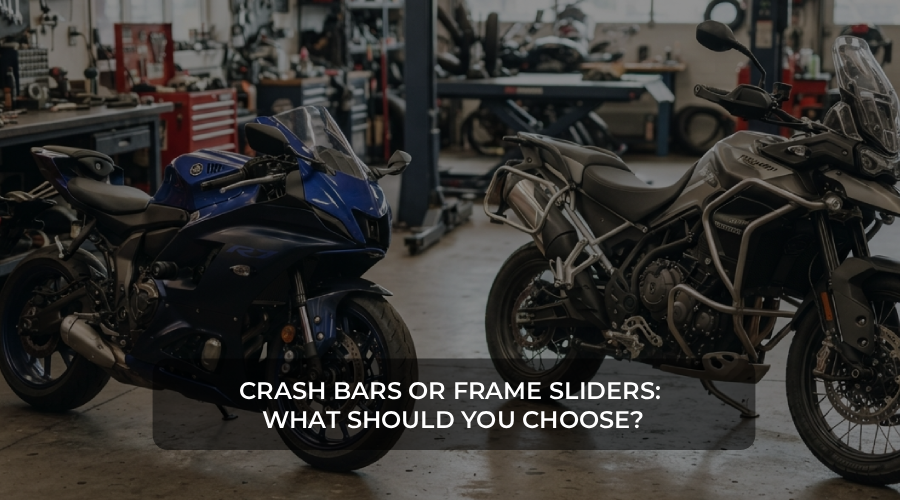
Crash Bars or Frame Sliders: What Should You Choose?
A motorbike will fall over when in a parking area, lose its balance when making a slow turn or wake after an unexpected accident within the road. The smallest accident may harm some of their expensive components, such as the engine casing, fairings, exhaust, and frame. That is why most riders believe it is better to add such safety devices as crash bars and frame sliders. The two accessories are developed to minimize damage to motorcycles, but they function differently. Crash bars are more extensive protection around the engine and the lower frame, whereas frame sliders are more localized protection at distinct mounting points. The correct decision is based on your motorcycle, riding style, and the kind of falls you would like to prepare. In this guide, we compare crash bars and frame sliders, explain their advantages and limitations, and help you decide which option suits your bike. What Are Motorcycle Crash Bars? Motorcycle crash bars (also called engine guards) are tubular metal bars that are fitted on the frame of the motorcycle or special mounting points. They tend to be circular around the engine and the lower part of the motorcycle to provide a protective shield. Also, crash bars are particularly useful for riders who want broader protection around the engine and lower frame. However, their effectiveness depends on the motorcycle’s design, mounting points, and the type of impact. What Are Frame Sliders? Frame sliders are small protective items that can be fastened to the frame section or engine supports of any motorbike. They are commonly manufactured out of nylon, polyurethane, Delrin or any other impact-resistant substances. Frame sliders are particularly common with sportbikes and street motorcycles since they offer focused protection at the cost of a non-tubular crash bar. Others fit without having to cut the fairing, and some actually need holes to be drilled into the bodywork of the motorcycle. Crash Bars vs Frame Sliders: Key Differences 1. Protection Coverage Crash bars generally offer wider coverage. They can help protect the engine, lower frame, exhaust components, and other parts depending on their design. Frame sliders provide more targeted protection. They are usually positioned near the frame, engine mount, or fairing and are designed to protect those specific areas. 2. Motorcycle Compatibility Both crash bars and frame sliders are usually model-specific. A product designed for one motorcycle may not fit another, even if both bikes have similar engine sizes or body shapes. Crash bars typically need to match the frame structure, engine position and mounting points. Frame sliders must also be compatible with the frame or engine mounting system. 3. Weight and Appearance The crash bars are larger and mostly increase the weight of a motorcycle. They also provide a more conspicuous look, which is desirable to some riders on cruisers and adventure bikes. Frame sliders are less noticeable and smaller. These only add a moderate amount of weight and do not tend to produce a significant effect on the overall looks of the motorcycle. 4. Installation Many model-specific crash bars attach directly to existing mounting points and do not require cutting or drilling. However, installation difficulty varies between motorcycles. Frame sliders can be easy to install when they use existing mounting points. Some designs, especially fairing-mounted sliders, require modifications to the bodywork. How Do Crash Bars Protect a Motorcycle? Crash bars are designed to create space between the motorcycle and the ground during certain falls. When the bike tips over, the bars may absorb some contact and prevent sensitive components from directly striking the road. They can be particularly useful during: Parking-lot falls Low-speed tip-overs Slow U-turn incidents Drops on uneven terrain Certain off-road falls However, crash bars are not designed to make a motorcycle crash-proof. During a high-speed collision, they may not prevent damage to the frame, engine or other parts. The design also matters. A guard that is poorly fitted or mounted to unsuitable points may not provide the protection expected from it. How Do Frame Sliders Work? Frame Sliders are constructed to serve as a contact point between the road and the motorcycle. They also have the ability, in some sliding crashes, to prevent bodywork and chosen mechanical parts from coming into contact with the surface. Their most common applications are on sportbikes since these are motorcycles whose fairings are usually expensive and may be ruined in the case of a low-side crash. For more information, read a guide on restoring motorcycle plastics to understand more about cleaning, repairing, and enhancing the appearance of motorcycle bodywork. FAQs 1. Is a crash guard on a bike illegal in India? In India, crash guards are not always illegal; however, illegal and unsafe crash guard accessories or those designed inadequately may involve legal liability and pose safety risks. 2. What is the difference between crash bars and highway bars? The main functionality of crash bars is to protect motorcycle parts such as the engine and the lower frame in case of some falls. Highway bars are a typical feature of cruiser and touring motorcycles. 3. Do crash bars really work? Yes, crash bars can help reduce damage during certain low-speed falls, parking incidents, and tip-overs. They may keep the engine casing, exhaust and lower bodywork away from direct contact with the ground. 4. Is an engine guard worth it? An engine guard may be worth considering if your motorcycle has exposed engine components or if you regularly ride in areas where low-speed falls are possible. In India, crash guards are not always illegal; however, illegal and unsafe crash guard accessories or those designed inadequately may involve legal liability and pose safety risks. The main functionality of crash bars is to protect motorcycle parts such as the engine and the lower frame in case of some falls. Highway bars are a typical feature of cruiser and touring motorcycles. Yes, crash bars can help reduce damage during certain low-speed falls, parking incidents, and tip-overs. They may keep the engine casing, exhaust and lower bodywork away from direct contact