
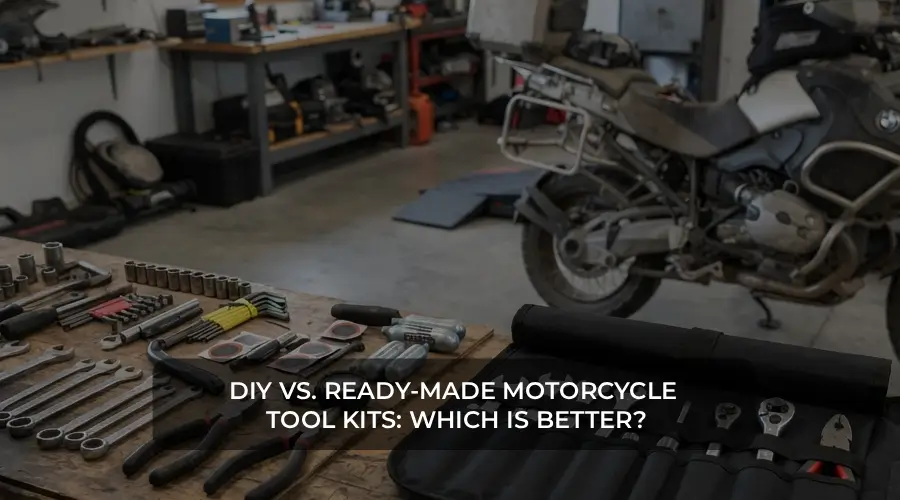
A motorcycle tool kit does not need to be large to be useful. For most riders, a compact set of essential tools is enough to handle common roadside problems, from loosening fasteners and making minor adjustments to dealing with punctures and simple electrical issues. The bigger question is whether you should build your own kit or buy a ready-made motorcycle tool kit. A DIY kit gives you complete control over the tools, sizes, and equipment you carry, while a pre-assembled kit saves time by bringing the essentials together in one package. Both options have their advantages. The right choice ultimately depends on your motorcycle, riding habits, mechanical knowledge, budget, and how prepared you want to be before heading out on the road. What Is a DIY Motorcycle Tool Kit? One type of DIY tool kit is a motorcycle tool kit, which one has to make themselves by choosing the tools individually based on the needs of his/her motorcycle. You do not need to purchase a generic set of tools, but you can tell the specific sizes and types of tools applied to your bike. You may select several combination wrenches, particular sockets, hex keys, a screwdriver, pliers, a tyre-repair kit and an inflater. This will be very handy when you already have equipment at home. You will only need to pick the smaller sizes that you require on the road rather than acquire a complete kit. Advantages of a DIY Tool Kit You Can Match It to Your Motorcycle Various bikes have different fasteners and parts. A DIY kit will enable you to choose what best fits your motorcycle. To take an example, when your bike just needs a small number of common hex sizes, then there is no use of possessing a large set. The same recommendation applies to the Rider Toolkit, which suggests assembling a motorcycle toolkit on the basis of the fasteners that are present in your bike rather than just having a big generic toolset. You Control the Quality Individual tools can be picked depending on the durability, size, and design. In case you already have good wrenches or sockets, they can be included with the kit. It is also because you can refuse to use low-quality tools, which can either bend, strip, or break at the time you most require them. You Can Keep It Lightweight A DIY kit may not occupy that much space since you bring what you require. An illustration is that, rather than buying a 40-piece socket set, you might only need to buy the few sockets that are needed for your motorcycle axle, controls, and fasteners. What Is a Ready-Made Motorcycle Tool Kit? A ready-made kit contains a pre-selected collection of tools assembled for motorcycle use. The main advantage is convenience. Instead of researching every tool separately, you purchase one kit and carry it in the supplied case or tool roll. A good ready-made kit may include wrenches, sockets, Allen keys, screwdrivers, pliers, and other motorcycle-specific equipment. Some are designed for general roadside repairs, while others focus on touring or adventure motorcycles. However, you still need to check the contents before buying. A ready-made kit isn’t automatically useful simply because it contains a large number of tools. Advantages of a Ready-Made Tool Kit Convenient to Buy The biggest advantage is simplicity. You don’t need to spend hours deciding which individual tools to purchase. This makes ready-made kits particularly useful for new riders who want basic roadside equipment without building a toolkit from scratch. Everything Stays Together A dedicated tool roll or case keeps your equipment organised. You are less likely to forget an individual wrench or leave an important tool at home. This becomes especially useful when travelling because you can quickly identify whether the complete kit is with you before leaving. Easier for Touring Long-distance riders often need a combination of basic hand tools and emergency equipment. A suitable ready-made touring kit can provide a useful starting point. Some specialised motorcycle toolkits are also designed to work with other touring equipment, such as tyre-repair systems or motorcycle jacks. DIY vs. Ready-Made: Which One Is Better? Feature DIY Kit Ready-Made Kit Customisation Excellent Limited Convenience Requires preparation Quick to buy Tool selection Completely controlled Pre-selected Weight Can be very low Depends on kit Research required Higher Lower Quality control In your hands Depends on manufacturer Best for Experienced or detail-oriented riders Beginners and convenience-focused riders The important point is that tool quantity isn’t the same as tool usefulness. FAQs 1. Who makes the highest-quality multi-tool? No single company that has widespread agreement of being the best manufacturer of multi-tools is available. Leatherman, Victorinox, Gerber, and SOG are some of the established players in the multi-tool industry, with various products targeting various solutions. 2. Are multi-tools actually useful? Yes. A multi-tool can be very useful for small repairs and adjustments because several functions are combined into one compact item. 3. Does the military use multi-tools? Yes, multi-tools and compact utility tools have been used in military and field environments, although the specific equipment varies between military organisations, roles and periods. 4. Which multi-tool is better, a Leatherman or a Swiss Army knife? Multi-tools with the Leatherman style tend to specialise in pliers and locking tools, drivers and repair-centred features. Swiss Army knives are generally more type-specifically designed and come in numerous designs. Victorinox has a long record of providing knives to the Swiss Armed Forces. No single company that has widespread agreement of being the best manufacturer of multi-tools is available. Leatherman, Victorinox, Gerber, and SOG are some of the established players in the multi-tool industry, with various products targeting various solutions. Yes. A multi-tool can be very useful for small repairs and adjustments because several functions are combined into one compact item. Yes, multi-tools and compact utility tools have been used in military and field environments, although the specific equipment varies between military organisations, roles and periods. Multi-tools with the Leatherman style tend to specialise in pliers and locking