
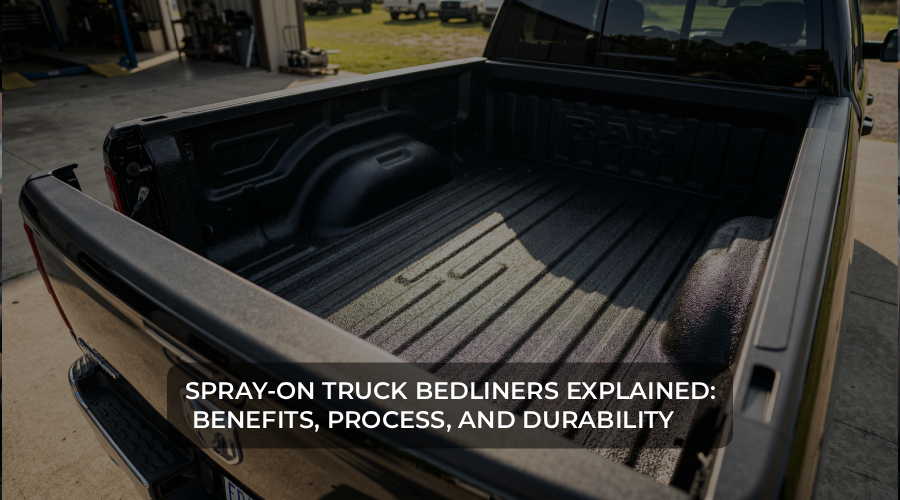
A pickup truck is designed to assist with hard tasks, but it is in the truck bed that the majority of the work occurs. Be it loading tools, moving furniture, transporting construction materials or simply going on a weekend journey, the bed is in constant contact, friction and weather every time. Over time, this results in scratches, dents, paint damage, and ultimately rust-out, particularly when the metal is not covered. This is why many truck owners prefer spray-on bedliners today. Unlike simple protective coatings, spray-on coatings provide a strong, long-lasting bond with your truck. They not only shield the surface but also increase the usability, minimise the maintenance, and keep your truck looking younger, longer than expected. When you are thinking about one, you should have a clear idea of how they operate and what they can provide to help you make the right choice. What Is a Spray-On Truck Bedliner? A spray-on truck bedliner is a protective lining that is sprayed on the truck bed by using special spraying machines. It is typically composed of tough materials such as polyurethane or polyurea, which are known for their toughness and compliance. When sprayed, the material adheres well to the metal surface and forms a thick, textured layer. Spray-on liners are permanent to the truck, unlike drop-in liners, which are placed on top of the bed. This implies that it has no crevices, no movement, and no room to hold moisture under it. Why Are More Truck Owners Choosing Spray-On Liners? Spray-on bedliners have gained popularity because they are more complete and long-term solutions than traditional liners. Their range offers durability, clean looks and functionality. To a large truck owner, it is not a question of how to keep the bed safe, but of enhancing the truck’s overall utility. You will particularly feel the difference when you are loading and offloading heavy and uneven weight on a regular basis. Key Benefits of Spray-On Truck Bedliners 1. Strong and Long-Lasting Protection Spray-on liners can be made to withstand repetitive use without becoming damaged. They are not easily scratched, dented, or damaged on the surface, even when subjected to heavy tool use or rough materials. This renders them suitable enough for both business and daily transportation. 2. Prevents Rust and Moisture Damage The covering sticks to the surface, creating a closed layer that blocks water and moisture. This will help avoid rusting in the long term, as one of the most common issues with the unguarded truck beds is especially during wet or rainy seasons. 3. Seamless and Custom Fit The ideal match is one of the greatest benefits. The liner is shaped along all the lines of the truck bed to cover all corners, edges and ridges without any gaps. This creates a factory-like finish that appears to be a part and not an addition. 4. Better Grip for Cargo It is also textured, making it have a frictional surface that is good at holding products during transit. Your goods will not roll around like boxes, equipment or luggage. This keeps your stuff safe as well as improves road safety. More affordable Suitable for older trucks Extensive choice of options and features. 5. Reduced Noise and Vibration A lesser-known benefit is noise reduction. Spray-on liners absorb vibrations that are generated as a result of cargo movement, thus minimising the rattling noise during driving. How is the Spray-On Bedliner Applied? The application process is detailed and plays a major role in the liner’s performance. A properly applied liner will last significantly longer and offer better protection. Step 1: Surface Preparation Cleaning and sanding the truck bed are performed first to remove dirt, rust, and previous coatings. This step is necessary to ensure the new material adheres adequately to the surface. Step 2: Masking Covering is done to all the surrounding areas that do not need to be coated, as well as side panels, lights, trims, etc. This makes the application accurate and neat. Step 3: Spraying the Material The liner material is sprayed uniformly on the entire truck bed by the high-pressure equipment. A thickness is controlled so as to provide uniform coverage. Step 4: Drying and Curing The coating is fast-setting, although it takes a long time to cure. Although it might dry in a matter of minutes, it takes approximately 24 hours to gain strength. Step 5: Final Check After the curing, the surface is examined for evenness of texture and for appropriate coverage. When the masking is eliminated, the truck is put into operation. How Durable Are Spray-On Bedliners? One of the largest reasons why people use spray-on liners is durability. Once done properly, they are capable of staying intact for years without peeling, cracking or slipping. They are meant to carry heavy weights, be sharp, and be used continuously without losing their performance. A truck bedliner is more than a coating on your truck bed; it is a lifetime enhancement that brings benefits in terms of performance and longevity. They are durable, have improved cargo stability and are also resistant to normal wear and tear, yet still have a clean and professional appearance. When you use your truck regularly for work or travel, one of the most effective investments you can make is a spray-on bedliner. It secures your truck, minimises maintenance and puts it on top of whatever you may put it through FAQs 1. How long does a spray-on truck bedliner last? A quality spray-on bedliner could last many years, which is usually the life of the truck, when well-maintained. Its life span is based on the utilization, the quality of materials, and installation. 2. Can a spray-on bedliner crack or peel? No, when used properly, the spray-on bedliners are meant to withstand cracking, peeling, and chipping. The installation may be poor, or the materials used may be of low quality. 3. How long does the installation process take? The app is typically a few hours, yet complete curing is about 24 hours. The best thing

Best Backup Cameras for Trucks: What to Look for Before You Buy
Backup cameras are a safety feature that has gained immense importance in modern-day trucks, as they assist drivers in controlling big blind spots and reversing safely. Whether driving your truck to work every day, off-road, or carrying heavy loads, a good rear-view system can significantly reduce the risk of an accident and improve overall control. Trucks are meant to be powerful and handy, but its size may prove to be difficult especially in congested or narrow spaces. That is where a good backup camera comes in, since it gives a clear picture of what is behind your car, which the mirrors cannot always do. However, one cannot always choose the right backup camera. There are various types, features, and opportunities of its installation in the market and one can easily get confused or even buy something that does not actually help to meet your requirements completely. We will discuss the most efficient truck backup cameras in this guide, the primary features to take into account, and some of the tips that will help you to make a reasonable, long-term decision. Why Backup Cameras Are a Must for Trucks? Pickup trucks are taller and larger with much larger blind spots than normal cars. The benefits of having a good backup camera are: See the low obstacles behind your truck that mirrors might miss Avoid collisions while reversing in tight areas Park more easily and accurately Improve safety when towing trailers or carrying loads Reduce stress while driving in crowded environments To the truck owners, the backup cameras are not a luxury; however, it is a practical safety enhancement that can improve control as well as confidence. Types of Backup Cameras for Trucks The key types that are offered should be learned before selecting features. 1. Wired Backup Cameras The wired systems are associated with reliability and stability. They are directly connected to your truck with cables, which provide: Stable signal with no interference High-quality video output Real-time display without lag The only negative side is that it can be slightly complicated to install, and thus professional assistance may be needed. Best for: Heavy-duty trucks, towing setups, and long-term use 2. Wireless Backup Cameras The wireless cameras are convenient and easy to install. They convey video on signals as opposed to cables. Pros: Quick and simple setup No need for complicated wiring Flexible and portable options Cons: Possible signal interference in some environments Slight delay in video feed Best for: Daily drivers and quick upgrades for older trucks 3. Multi-Camera Systems A single rear camera might not be sufficient in case of bigger truck or high-tech use. Multi-camera systems consist of: Rear camera Side cameras Front or trailer cameras These systems give you a total view of the area around your car and this becomes exceptionally handy during towing or when having to work around in tight areas. 4. OEM vs Aftermarket Cameras OEM Cameras Fitted by the manufacturer. Integrated into the truck system in totality. More expensive but smooth operation. Aftermarket Cameras More affordable Suitable for older trucks Extensive choice of options and features. The most commonly used system to upgrade the truck that does not have inbuilt cameras is the aftermarket systems. Key Features to Look for Before Buying Backup Cameras The majority of the performance of a camera depends not only on the type chosen, but also on the capabilities. 1. Image Quality (Resolution) Whenever you buy a camera, always ensure it has a minimum resolution of 720p or 1080p HD. A greater clarity will help you notice: Small obstacles Road edges Low-lying objects 2. Night Vision Nighttime driving or parking must be seen. Look for cameras with: Infrared night vision LED enhancement This ensures you can see clearly even in low-light conditions. 3. Wide Viewing Angle A wider angle means better coverage. The ideal range is 120° to 170°, allowing you to see more of your surroundings. 4. Waterproof and Durability Rating Backup cameras are open to the elements outdoors hence durability is necessary. Look for ratings like: IP67 IP68 IP69 These guarantee protection against dust, mud and rain. 5. Display Options The footage provided by the backup camera may be shown on: Rearview mirror screens Dashboard monitors Inbuilt entertainment systems. Select a truck display that fits your truck layout. 6. Parking Guidelines Numerous cameras have visual instructions on the screen. These help you: Align your vehicle Judge distance Park accurately Wired vs Wireless: Which One Should You Choose? When performance and reliability are of importance, then wired systems are preferable. Wireless systems are more convenient in case you want to install them easily and be more flexible. Wired systems are normally suggested in cases of heavy-duty usage, towing or professional purposes. Common Mistakes to Avoid The following are some of the pitfalls that should be avoided when purchasing a backup camera: Choosing low-resolution cameras Ignoring waterproof ratings Not checking compatibility with your truck Overlooking installation requirements Going for the cheapest option without considering quality A camera of bad quality will violate the safety rather than enhance it. The choice of a backup camera to install in your truck rests on the usage of the camera and what features would best fit your needs. Whether it is a long-term reliability system wired or an easy-to-install wireless system, a high-quality backup camera will increase the security, visibility, and driving confidence of the vehicle. The factor does not revolve solely around convenience; to truck owners, it is all about making each reverse safer, smoother, and more controlled. FAQs 1. Are backup cameras necessary for trucks? Older trucks are not always required to have them, though, they are strongly suggested to be safe as well as convenient. 2. Can I install a backup camera myself? Yes, in particular, wireless systems. Wired systems can be more difficult or professional to install. 3. Do backup cameras work in rain and dust? Yes, if they have proper waterproof ratings like IP67 or higher. 4. Can backup cameras be used all the time? There