





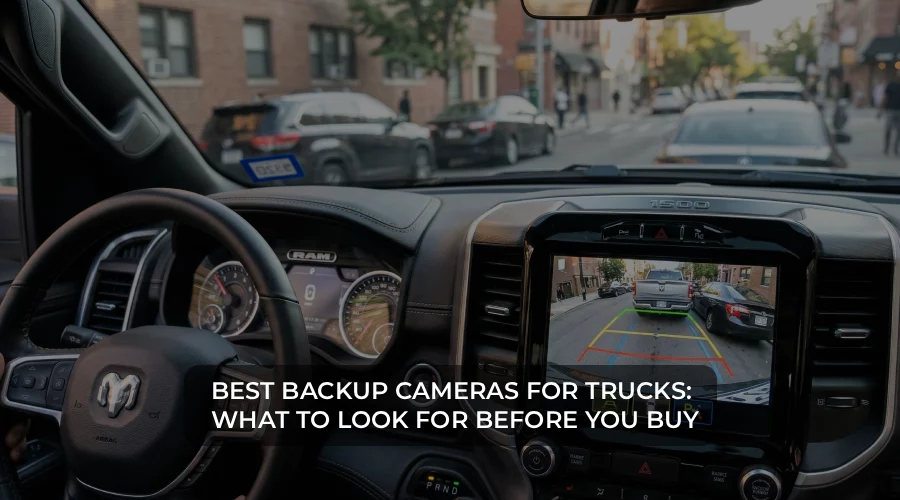
Backup cameras are a safety feature that has gained immense importance in modern-day trucks, as they assist drivers in controlling big blind spots and reversing safely. Whether driving your truck to work every day, off-road, or carrying heavy loads, a good rear-view system can significantly reduce the risk of an accident and improve overall control.
Trucks are meant to be powerful and handy, but its size may prove to be difficult especially in congested or narrow spaces. That is where a good backup camera comes in, since it gives a clear picture of what is behind your car, which the mirrors cannot always do.
However, one cannot always choose the right backup camera. There are various types, features, and opportunities of its installation in the market and one can easily get confused or even buy something that does not actually help to meet your requirements completely.
We will discuss the most efficient truck backup cameras in this guide, the primary features to take into account, and some of the tips that will help you to make a reasonable, long-term decision.
Why Backup Cameras Are a Must for Trucks?
Pickup trucks are taller and larger with much larger blind spots than normal cars.
The benefits of having a good backup camera are:
- See the low obstacles behind your truck that mirrors might miss
- Avoid collisions while reversing in tight areas
- Park more easily and accurately
- Improve safety when towing trailers or carrying loads
- Reduce stress while driving in crowded environments
To the truck owners, the backup cameras are not a luxury; however, it is a practical safety enhancement that can improve control as well as confidence.
Types of Backup Cameras for Trucks
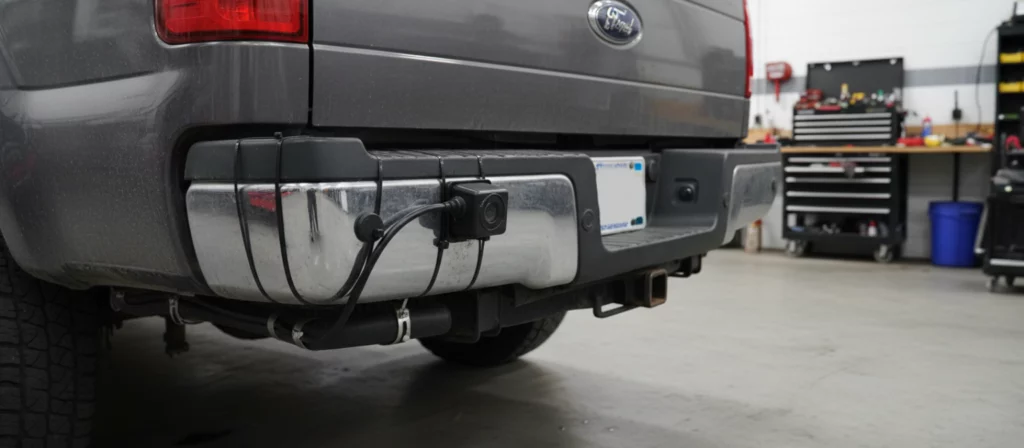
The key types that are offered should be learned before selecting features.
1. Wired Backup Cameras
The wired systems are associated with reliability and stability.
They are directly connected to your truck with cables, which provide:
- Stable signal with no interference
- High-quality video output
- Real-time display without lag
The only negative side is that it can be slightly complicated to install, and thus professional assistance may be needed.
Best for: Heavy-duty trucks, towing setups, and long-term use
2. Wireless Backup Cameras
The wireless cameras are convenient and easy to install. They convey video on signals as opposed to cables.
Pros:
- Quick and simple setup
- No need for complicated wiring
- Flexible and portable options
Cons:
- Possible signal interference in some environments
- Slight delay in video feed
Best for: Daily drivers and quick upgrades for older trucks
3. Multi-Camera Systems
A single rear camera might not be sufficient in case of bigger truck or high-tech use.
Multi-camera systems consist of:
- Rear camera
- Side cameras
- Front or trailer cameras
These systems give you a total view of the area around your car and this becomes exceptionally handy during towing or when having to work around in tight areas.
4. OEM vs Aftermarket Cameras
OEM Cameras
- Fitted by the manufacturer.
- Integrated into the truck system in totality.
- More expensive but smooth operation.
Aftermarket Cameras
- More affordable
- Suitable for older trucks
- Extensive choice of options and features.
The most commonly used system to upgrade the truck that does not have inbuilt cameras is the aftermarket systems.
Key Features to Look for Before Buying Backup Cameras
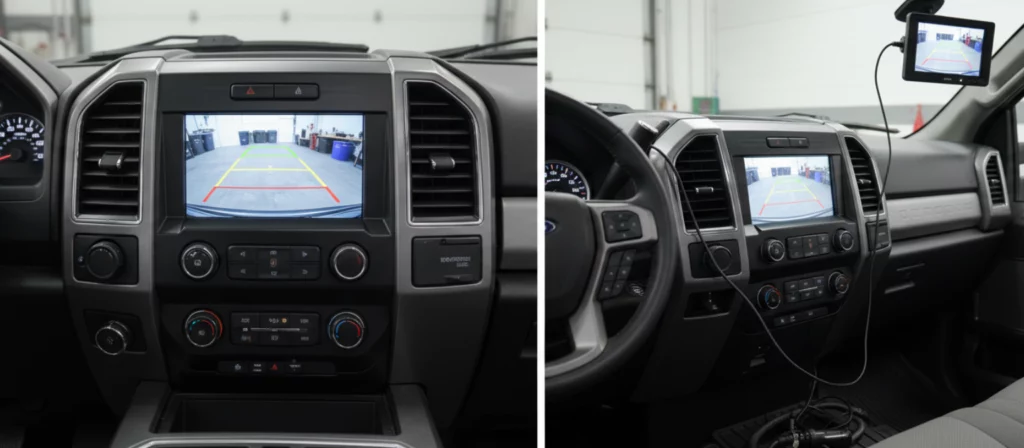
The majority of the performance of a camera depends not only on the type chosen, but also on the capabilities.
1. Image Quality (Resolution)
Whenever you buy a camera, always ensure it has a minimum resolution of 720p or 1080p HD. A greater clarity will help you notice:
- Small obstacles
- Road edges
- Low-lying objects
2. Night Vision
Nighttime driving or parking must be seen. Look for cameras with:
- Infrared night vision
- LED enhancement
This ensures you can see clearly even in low-light conditions.
3. Wide Viewing Angle
A wider angle means better coverage. The ideal range is 120° to 170°, allowing you to see more of your surroundings.
4. Waterproof and Durability Rating
Backup cameras are open to the elements outdoors hence durability is necessary. Look for ratings like:
- IP67
- IP68
- IP69
These guarantee protection against dust, mud and rain.
5. Display Options
The footage provided by the backup camera may be shown on:
- Rearview mirror screens
- Dashboard monitors
- Inbuilt entertainment systems.
Select a truck display that fits your truck layout.
6. Parking Guidelines
Numerous cameras have visual instructions on the screen. These help you:
- Align your vehicle
- Judge distance
- Park accurately
Wired vs Wireless: Which One Should You Choose?
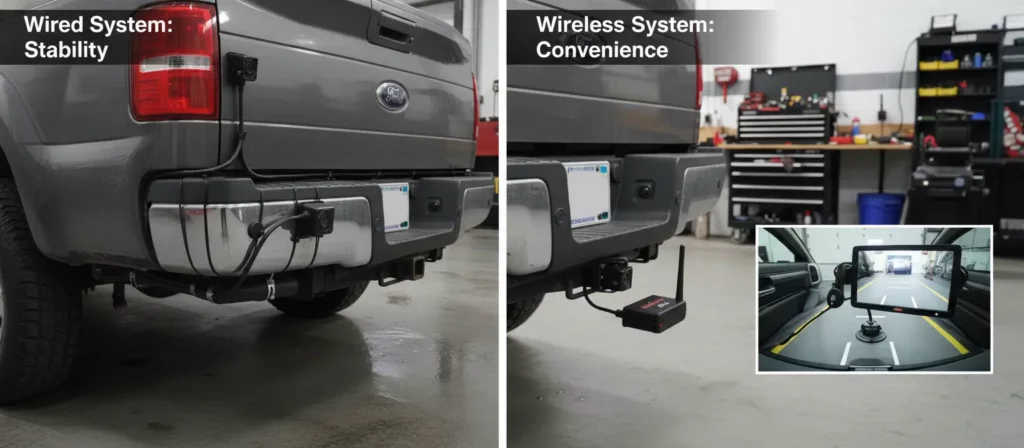
When performance and reliability are of importance, then wired systems are preferable. Wireless systems are more convenient in case you want to install them easily and be more flexible. Wired systems are normally suggested in cases of heavy-duty usage, towing or professional purposes.
Common Mistakes to Avoid
The following are some of the pitfalls that should be avoided when purchasing a backup camera:
- Choosing low-resolution cameras
- Ignoring waterproof ratings
- Not checking compatibility with your truck
- Overlooking installation requirements
- Going for the cheapest option without considering quality
A camera of bad quality will violate the safety rather than enhance it.
The choice of a backup camera to install in your truck rests on the usage of the camera and what features would best fit your needs.
Whether it is a long-term reliability system wired or an easy-to-install wireless system, a high-quality backup camera will increase the security, visibility, and driving confidence of the vehicle.
The factor does not revolve solely around convenience; to truck owners, it is all about making each reverse safer, smoother, and more controlled.
FAQs
1. Are backup cameras necessary for trucks?
Older trucks are not always required to have them, though, they are strongly suggested to be safe as well as convenient.
2. Can I install a backup camera myself?
Yes, in particular, wireless systems. Wired systems can be more difficult or professional to install.
3. Do backup cameras work in rain and dust?
Yes, if they have proper waterproof ratings like IP67 or higher.
4. Can backup cameras be used all the time?
There are systems you can see continuously, but most are activated when the vehicle is in reverse.