

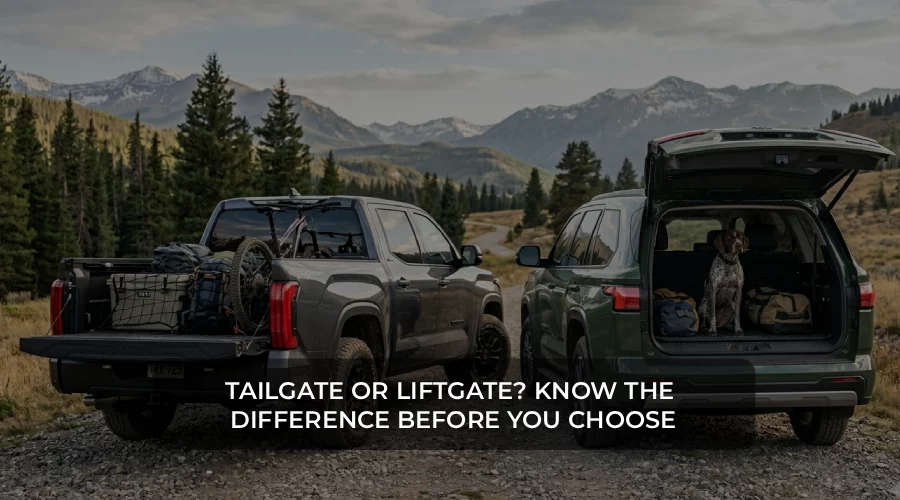
When purchasing an automobile, SUV, or pick-up truck, a minor feature could mean a lot in your day-to-day life, such as the rear door. Tailgate and liftgate are two terms that have been used interchangeably by many people. Actually, they are used for various purposes, fit various vehicles, and affect convenience, safety, and usability.
This step-by-step guide will help you see the difference, advantages, and disadvantages of choosing the right one.
What Is a Tailgate?
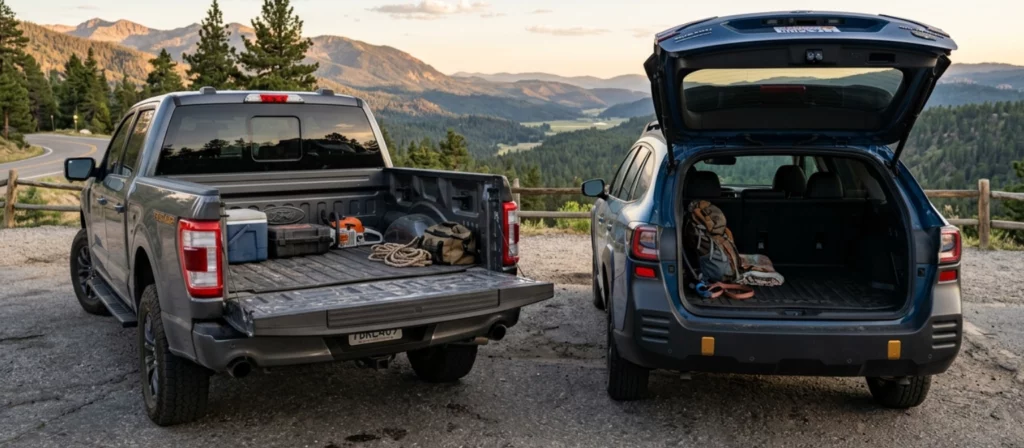
A tailgate is a door at the back of a pickup truck. It is pinned at the bottom and folds downwards to make a flat surface.
They are most commonly associated with trucks and open by folding down rather than lifting upward.
Key Features of a Tailgate:
- Lies horizontally (down position).
- Forms a long loading platform.
- Commonly found in pickup trucks.
- Usually manually operated (but powered models are available).
Why People Love Tailgates:
- Perfect for transporting heavy goods.
- May be used as a bench or desk.
- Excellent in the field (camping, sporting, etc.)
What Is a Liftgate?
A liftgate is a rear door typical of SUVs, hatchbacks, and crossovers. It opens upward, providing access to a fully enclosed cargo space.
Liftgates can be commonly assisted by gas struts or powered devices, which are more convenient to use.
Key Features of a Liftgate:
- Opens up (vertical movement).
- Protects a closed cargo space.
- These are mounted on SUVs, vans, and hatchbacks.
- Frequently has power or hands-free features.
Why People Prefer Liftgates:
- Accessibility of groceries and luggage.
- Protection from rain while loading
- Easy to use
Tailgate vs Liftgate: Core Differences
It is easier to understand when you contrast them.
1. Opening Mechanism
- Tailgate: Drops down flat
- Liftgate: Lifts upward
A tailgate forms a platform, whereas a liftgate is similar to a door.
2. Vehicle Type
- Tailgate: Pickup trucks
- Liftgate: SUVs, hatchbacks, crossovers
Tailgates are used in most trucks, and liftgates in family vehicles.
3. Usage Purpose
- Tailgate: Transporting big or heavy products.
- Liftgate: Stress-free access to sealed cargo.
A tailgate is more utility-oriented than a liftgate, which is convenience-oriented.
4. Power & Technology
- Tailgate: Generally manual (there are powered tailgates available today).
- Liftgate: Sometimes powered or hand-free.
Liftgates are more advanced regarding automation.
5. Everyday Convenience
- Tailgate: Better for hauling
- Liftgate: Better for daily errands
Pros and Cons: Tailgate vs Liftgate
Tailgate Pros:
- Strong and durable
- Perfect for carrying heavy objects.
- Can be used as a platform or a seat
Tailgate Cons:
- Takes greater effort to raise.
- Weather, no shelter.
- Not so easy to use every day.
Liftgate Pros:
- Easy to open (particularly powered)
- Insures against the weather.
- Perfect in the city and with family.
Liftgate Cons:
- Limited loading platform
- Can be heavy without power assist
- The cost of repairs is higher.
Which One Should You Choose?
Your choice depends on how you use your vehicle.
Choose a Tailgate if:
- You have or are going to purchase a pickup truck.
- You deliver large or bulky products.
- You like outdoor activities such as camping or tailgating.
Choose a Liftgate if:
- You are an SUV/Hatchback driver.
- You are convenient- and comfort-loving.
- You often carry groceries, bags, or luggage.
For safe and practical usage tips, don’t miss our detailed guide on best ways to safely tailgate with a truck, where you’ll learn how to handle your tailgate securely in real-world situations.
Hybrid Designs: Best of Both Worlds

There are modern cars that combine the two ideas.
Some SUVs have split tailgates, in which:
- The top is opened like a liftgate.
- The bottom is folded tailgate fashion.
This design is flexible and is increasingly getting popular in high-end SUVs.
Power Tailgate vs Manual Tailgate
The current cars are changing, particularly the power tailgates and liftgates. The power liftgate has electric motors and sensors to open automatically by a button or foot gesture, which is highly convenient to use in everyday life.
Advantages of Power Options:
- Hands-free access
- The safer and smoother operation.
- Best when you have your hands full.
Whether you need a tailgate or a liftgate will always depend on your lifestyle, driving needs, and day-to-day use of a car. Tailgate is made sturdy and user-friendly so it can be used for carrying heavy loads, outdoor activities, and professional tasks. Liftgate on the other side is a more convenient design with easy access, improved weatherproofing, and better features, and is therefore easier to use in daily life.
A tailgate will be more appropriate for your utility and rough needs. But when you are more box-oriented towards comfort, ease of use, and friendliness to both the family, then a liftgate will be useful. These days, there are plenty of electric and hybrid models to choose from, so you can pick the one that best suits you.
This makes them a one-time investment for long-term use.
FAQs
1. What is the difference between a tailgate and a liftgate in a car?
A tailgate is the rear door that folds downwards on the back of the truck, often seen on pickup trucks, and a liftgate is the door that rises up and is seen often on SUVs and hatchbacks. The major differences are their design, purpose, and type of vehicle.
2. Is a power tailgate worth the extra cost?
Yes, when convenience is important to you. A power tailgate/liftgate can be used, which is hands-free, so that even when you have your hands full, it is still possible to load things. It also provides a high-quality touch and enhances everyday functionality.
3. Does opening your tailgate save gas?
Not significantly. Although some claim that lowering the tailgate makes the vehicle more fuel-efficient, research typically indicates that the effect on actual driving is minor or non-existent.
4. Can you leave your tailgate open while driving?
It is subject to local laws and safety. It may be okay to carry long objects with an open tailgate within short distances, but it is not a safe procedure, and one can be fined in some areas. So, when you have a load, always lock it.