



Ever had to hit the brakes a little harder than expected… and heard something shift behind you?
That split-second moment when you glance in the mirror and think, “Hope nothing’s coming forward…”, yeah, that’s exactly where a headache rack proves its worth. For many pickup truck owners, especially those who carry tools, ladders, pipes, or heavy gear, the space right behind the cab is the most vulnerable zone. One sudden stop, and unsecured cargo can slide forward, sometimes with serious consequences.
A headache rack is designed to stop that. However, it is no longer about safety. The headache racks have been developed to be more of a multi-purpose upgrade in 2026 to offer protection, storage, style, and long last ability. We will start by simplifying it so you can understand what headache racks are, the various rack types, and why they are an excellent investment for your truck.
What Is a Headache Rack?
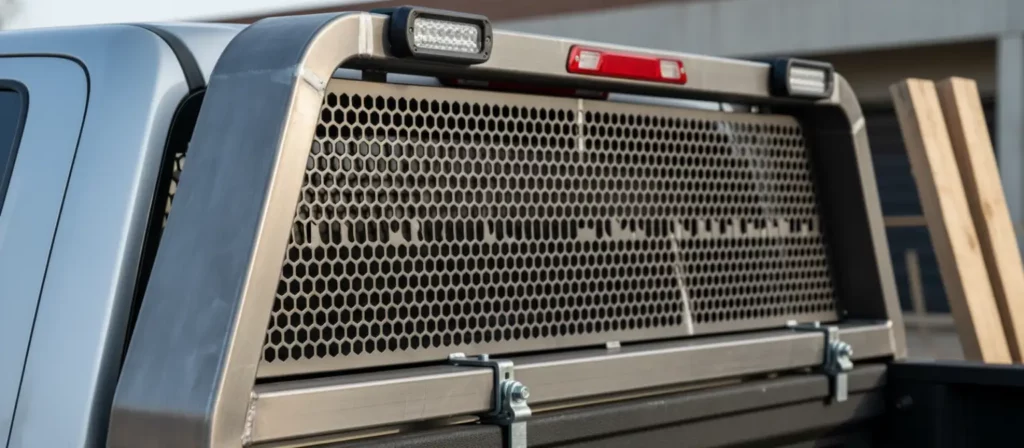
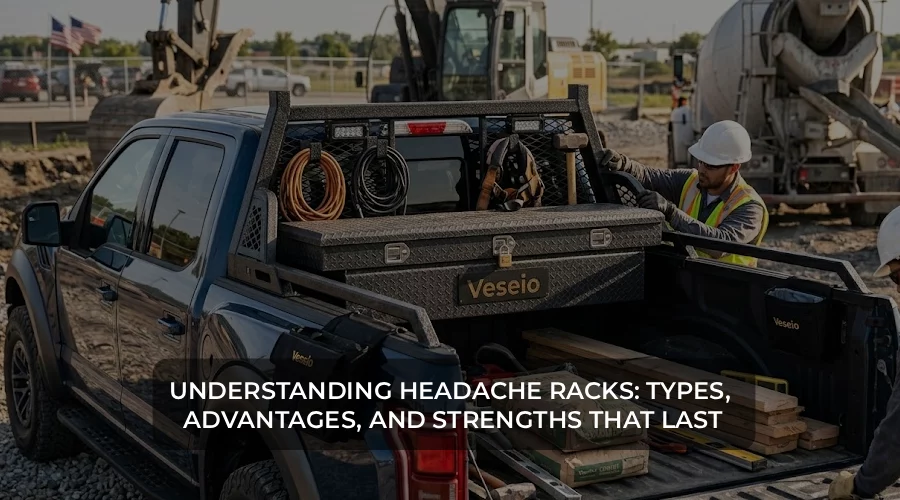
A headache rack is a tough frame or a barrier that is fixed directly behind the pickup truck cab. All it does is keep the rear and passengers out of the way of the rolling cargo.
If you’re carrying long or heavy items like:
- Lumber
- Pipes
- Ladders
- Tools
- Construction materials
The headache rack serves as a shield, and the said items do not slide forward as a result of sudden braking. However, in addition to protection, modern headache racks are also equipped with:
- Mounting options for tools and lights
- Tie-down points for securing cargo
- Enhanced truck aesthetics
Types of Headache Racks
The headache racks are not all designed the same way. The right one is based on the way you put your truck to use.
1. Mesh Headache Rack
Mesh racks are the most widespread and convenient ones. They have a metal mesh panel that is in the middle of a steel frame.
Why choose it?
- Allows good rear visibility
- Lightweight compared to solid racks
- Still provides strong protection
This is the most convenient type to use on daily occasions, and it is also the one that you would want to be cautious as well as visible.
2. Solid Panel Headache Rack
Racks made of solid are with full metal plate rather than mesh. They are the most protective, particularly when it comes to heavy workplaces.
Best for:
- Construction work
- Carrying heavy or sharp materials
- Maximum rear window safety
The trade-off? Slightly reduced rear visibility.
3. Louvered Headache Rack
Louvered racks are placed between mesh and solid designs.
They use angled slats that:
- Provide airflow
- Maintain visibility
- Offer solid protection
- Avoid uneven or tilted loads
The design is excellent as it can be durable, along with airflow, which is essential in hot climates.
4. Headache Rack with Storage
Headache racks have storage cubbies or tool mounts incorporated into them. These are ideal to store:
- Tools
- Chains
- Straps
- Equipment
5. Headache Rack with Light Mounts
In various racks, mounts have been added for:
- LED work lights
- Spotlights
- Off-road lighting
This is especially useful for:
- Night work
- Off-road driving
- Campsite setups
Materials Used in Headache Racks
A headache rack is made of a material that depends greatly on the strength and durability. The following are the most common types of headache racks:
Steel Headache Racks
- Extremely strong and durable
- Ideal for heavy-duty use
- Can handle high impact
They are, however, heavier and could influence fuel efficiency a bit.
Aluminium Headache Racks
- Lightweight
- Rust-resistant
- Easier to install
Although they are not as strong as steel, they can be used daily and during light to medium loads.
Advantages of Installing a Headache Rack
A headache rack may seem to be a mere addition to the main product, yet it has serious advantages.
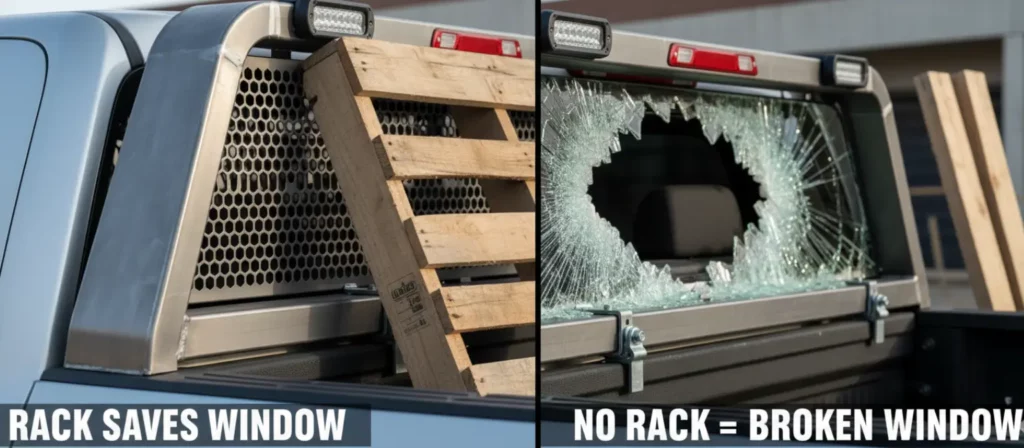
1. Protects Your Rear Window
This is the greatest advantage. Even a single loose statement may break your rear glass, which is very expensive to repair. That is prevented by a headache rack.
2. Improves Cargo Safety
It acts as a concrete lid, and cargo does not move. It is particularly necessary at:
- Sudden braking
- Sharp turns
- Uneven roads
3. Adds Mounting and Storage Options
Modern racks come with:
- Hooks
- Brackets
- Storage panels
This helps you organize tools and gear efficiently.
4. Enhances Truck Appearance
Honestly, though, the good headache rack will make your truck look more rugged and professional.
It gives your vehicle a work-ready, high-end touch.
5. Long-Term Durability
Good headache racks are constructed to be durable. When well-materialized and coated, they can survive:
- Rain
- Dust
- Heat
- Heavy usage
This makes them a one-time investment for long-term use.
How Strong Are Headache Racks?
This is a common question, and an important one. The strength of a headache rack depends on:
- Material (steel vs aluminium)
- Build quality
- Mounting system
The heavy-duty steel racks can take a lot of impact because of moving the cargo, and therefore, they are ideal to be used by professionals.
Nevertheless, one should keep in mind: a headache rack is not a substitute for adequate tie-downs, but rather a protective barrier.
You should always lock up your cargo and have a rack.
Do You Really Need a Headache Rack?
It depends on how you use your truck. You should strongly consider one if you:
- Carry long or heavy materials regularly
- Use your truck for work (construction, delivery, etc.)
- Transport tools or equipment
- Want added safety and organization
Even for casual users, it adds an extra layer of protection and utility.
A headache rack is one of those upgrades that quietly does its job until the moment you really need it. Whether it is to secure your rear window or enhance your cargo organisation, along with other features and functionalities, it is a smart accessory for any pickup truck owner who cares about their safety and longevity.
Whether it is a lightweight aluminium rack or a heavy-duty structure, the type of rack can transform your truck into a more competent, more organised, and much safer vehicle on the road. Cargo capacity is more than enough, and since it is always better to be safe than sorry, always be ready.
FAQs
1. Will a headache rack block rear visibility?
Mesh and louvered designs have good visibility. It can be reduced by solid racks to a certain degree.
2. Can I install a headache rack myself?
Yes, many of the models can be installed using simple tools.
3. Are headache racks universal?
Some are universal but most of them are model-specific and thus fit and are more stable on models of trucks.
4. Do headache racks affect fuel efficiency?
Heavy racks of steel can have a marginal effect, but it is most often negligible.
5. Can I use a headache rack without securing cargo?
No. Always use straps or tie-downs. The rack is an additional safety layer, not the only one.